The Overlooked Midlife Reset: Why Stretching Matters More Than You Think After 50
Mar 24, 2026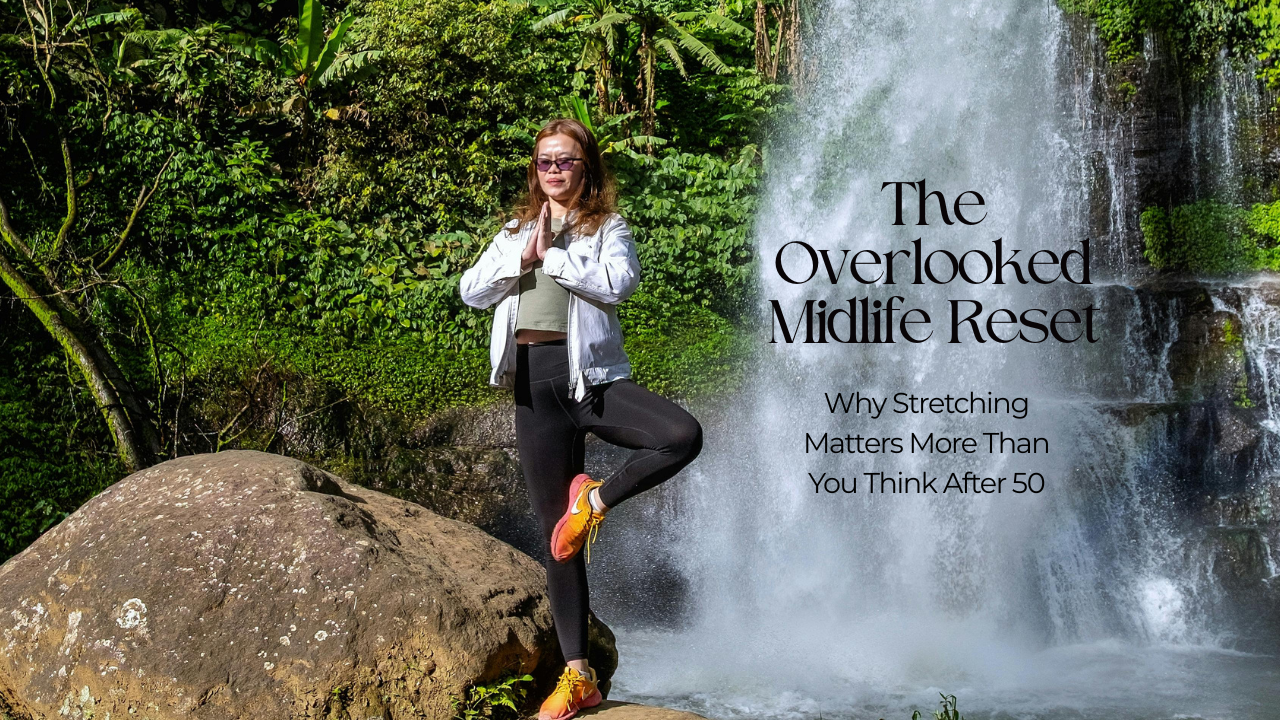
There is a subtle shift that happens in midlife that is easy to overlook at first.
You notice it when you stand up after sitting for a while and it takes a moment longer to feel fully upright. When reaching for something feels slightly less fluid than it once did. When your body no longer feels like something you move in effortlessly, but something you are becoming more aware of.
It is not pain. Not necessarily stiffness in the clinical sense. More a quiet sense of restriction.
And for many professional women, it is something that gets ignored.
Because you are still functioning. Still managing your day. Still moving, exercising, and doing what needs to be done. So it does not feel urgent.
It is a reflection of how your body is changing.
The Midlife Body Becomes Less Forgiving of Neglect
In earlier years, your body had a remarkable ability to compensate.
Long days, limited recovery, inconsistent movement patterns, all of it could be absorbed without much visible consequence. Flexibility, mobility, and joint range were maintained without needing much direct attention.
In midlife, that changes.
As collagen production declines and connective tissue becomes less elastic, your muscles and joints require more intentional care to maintain their range of motion. At the same time, reduced activity variability, particularly if your work involves long periods of sitting or repetitive movement, begins to show up more clearly in the body.
The result is not just stiffness.
It is a gradual loss of efficiency in how you move.
Why This Matters More Than It Seems
Stretching is often framed as something optional, something you do if you have time, or something reserved for athletes or yoga enthusiasts.
But in midlife, stretching becomes something far more significant.
Mobility influences how your body distributes load. When certain areas become restricted, others compensate. Over time, this can lead to tension patterns, discomfort, and an increased risk of injury.
It also affects how effectively you can perform other forms of exercise. Strength training, walking, even daily tasks all rely on your joints being able to move through a full and controlled range.
When that range is limited, your body adapts, often in ways that are less efficient and more taxing.
There is also a neurological component.
When your body feels tight or restricted, your nervous system often interprets this as a signal to remain slightly guarded. This can contribute to a low level sense of tension that many women carry without fully realising it.
Stretching as a Way to Restore Ease
When you stretch, particularly in a slow and controlled way, you are not just lengthening muscle. You are communicating with your nervous system.
You are showing your body that it can move safely through a greater range. Over time, this reduces the need for protective tension and allows movement to feel more fluid again.
This is why stretching often feels like more than a physical change. There is a sense of space that returns, both in the body and in how you experience movement.
What This Looks Like Practically
The effectiveness of stretching in midlife does not come from intensity, but from consistency.
Short, regular sessions are far more impactful than occasional longer ones. This might look like five to ten minutes in the morning to ease into the day, or a brief session in the evening to release accumulated tension.
Focusing on key areas such as the hips, hamstrings, shoulders, and spine can make a noticeable difference, as these are often where restriction develops first.
The key is not to push aggressively, but to allow the body to gradually open.
The Connection to Strength and Longevity
Stretching does not replace strength training. It supports it.
When your body moves more freely, you are able to engage muscles more effectively and with better alignment. This improves the quality of your strength work and reduces the likelihood of strain.
Over time, this combination of strength and mobility supports not just how your body looks, but how it functions.
It becomes easier to move well, to recover, and to maintain independence as you age.
A More Refined Way to Think About Stretching
Stretching in midlife is not about becoming more flexible in a performative sense.
It is about maintaining access to movement.
It is about ensuring that your body continues to feel like something you can rely on, rather than something you have to work around.
For women who are used to moving through life efficiently, this can be a subtle but important shift.
Because when movement becomes easier, everything else begins to feel lighter.
And that is what makes stretching one of the most powerful tools you can use in this stage of life.
Stay connected with news and updates.
Join our mailing list to receive the latest news and updates from our team.
Don't worry, your information will not be shared.
We hate SPAM. We will never sell your information, for any reason.